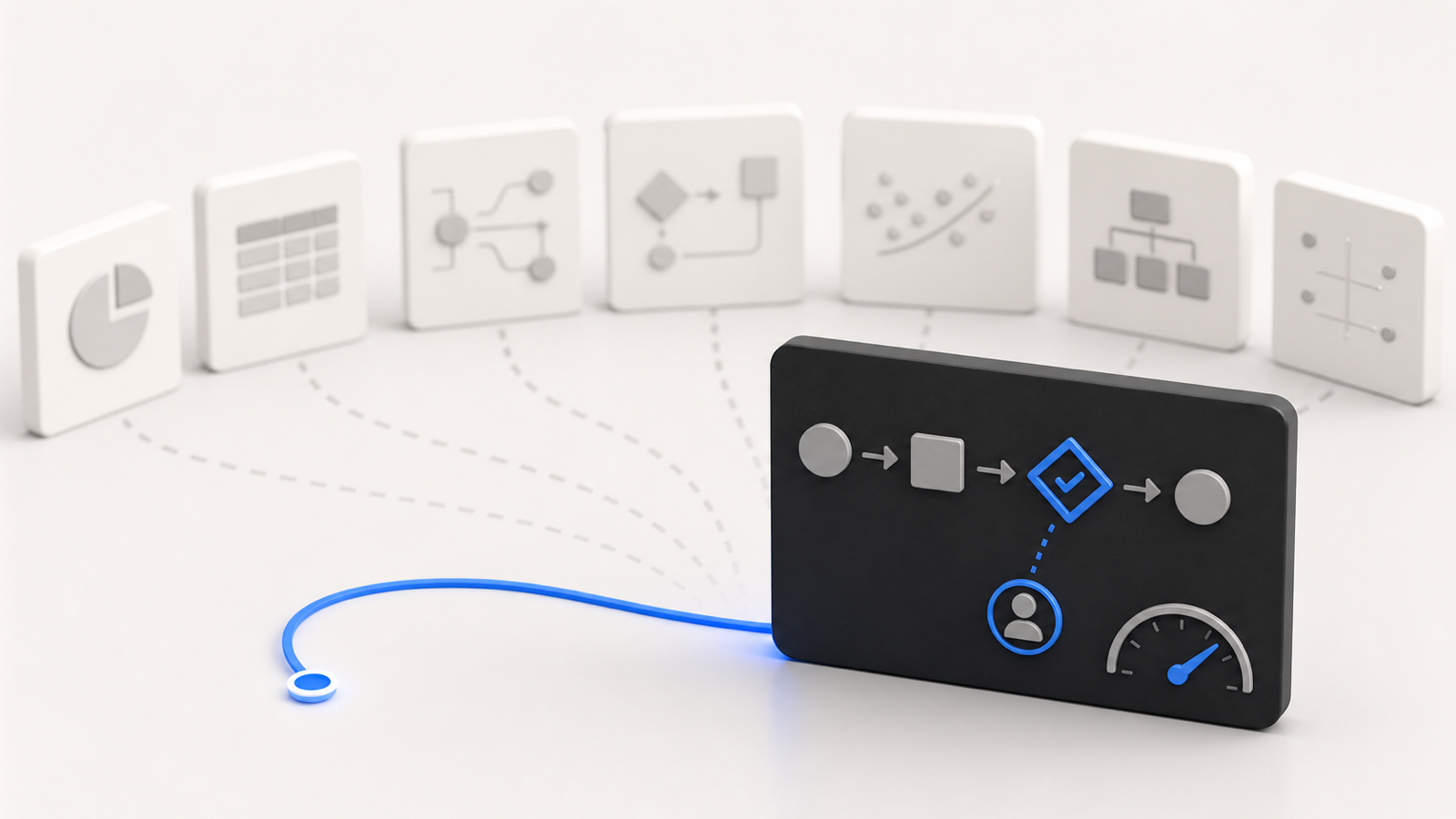
What should a business build first? The first idea is often the flashy one — a chatbot on the website, an agent that handles customer support end to end, or something that belongs in a demo video. That is what shows up in the feed. But first projects that pay off for a small business rarely look impressive from the outside. They look boring. That is the point.
Three filters matter together. First: does this eat a large, recurring chunk of somebody's time right now? Second: if the AI gets it wrong, is the damage small and recoverable, or does it touch money, legal exposure, or a customer relationship you cannot afford to bruise? Third: can you measure whether it worked with a number rather than a feeling? A high-value but unmeasurable project can die in a later argument about whether it is really helping. A measurable task with little time cost is not worth the setup. Look for all three at once.
Start with where the hours actually go. Not where you assume they go — where they go. Most small businesses have some recurring task that eats real time every single week: drafting the same kind of email over and over, summarizing call notes, matching invoices to purchase orders, writing first-draft responses to routine customer questions, pulling together a status update from five different sources. These tasks share a quality: they're tedious enough that nobody enjoys doing them, but structured enough that a first draft from a model gets you most of the way there. That combination — high frequency, moderate structure, low enjoyment — is exactly what you're hunting for.
Now run it through the risk filter, and this is where the agents-versus-workflows distinction actually earns its keep instead of being a curriculum abstraction. A fully autonomous agent that decides things and acts on its own — sends the email, updates the record, tells the customer yes or no — carries real risk on day one, because you haven't yet built the judgment to know when it's wrong. A workflow where the model drafts and a human reviews before anything goes out carries almost none, because the worst case is you edit or delete a draft, exactly like you'd edit an email a junior employee wrote. For a first project, pick the version with a human still in the loop at the point where a mistake would actually cost you something. You can automate the review step away later, once you've watched it perform for a while and trust it.
The measurement question is the one people skip, and it's the one that determines whether you ever get a second project approved. Before you build anything, write down what 'better' looks like in a number: hours per week freed up, average response time cut in half, error rate on some check dropped from one in ten to one in fifty. Then actually track the before number for a week or two before you touch any AI, because your memory of 'how long this used to take' is unreliable and you'll want the real baseline later when someone asks if this was worth it. Without that baseline, six months from now you'll have a vague sense that things feel better, which is not something you can put in front of a partner, a spouse, or your own future skeptical self when deciding whether to invest further.
On model and cost, the first project is not the place to reach for the most expensive, most capable option available. Simple, well-scoped drafting and summarization tasks — which is what most good first projects are — get handled well by cheaper, faster models, and the cost difference compounds fast once you're running something daily. Save the expensive, heavyweight reasoning for problems that are genuinely hard: multi-step analysis, ambiguous judgment calls, anything where a cheaper model visibly struggles. Testing this yourself takes an afternoon, not a consultant. Run the same real task through a couple of options and see if the cheap one is actually good enough — it usually is, for the boring stuff, and 'boring stuff' is exactly what your first project should be.
On data, the rule is: use what you already have lying around, don't go build a new pipeline to feed it. If your first project needs you to first construct a clean database, tag a thousand documents, or stand up new infrastructure just to get started, you've picked the wrong first project — that's a phase-two problem at best. Your existing email threads, past support tickets, your FAQ doc, your pricing sheet, last year's proposals — that's usable data sitting right there. A good first project points a model at documents you already have and asks it to draft, summarize, or search, not one that requires you to build a data operation before you've proven the concept is worth the effort at all.
Fictional example using synthetic figures: A small logistics brokerage considers a customer-facing bot that quotes shipping rates automatically — high visibility, high risk, and hard to measure safely because a wrong quote costs money and trust. It chooses something duller: drafting routine shipment-status and updated-ETA emails from data already in the tracking system. A person still approves every send. In the demonstration, drafting time falls from about six minutes to under one across hundreds of monthly emails. Those figures illustrate what to measure; they are not customer results.
Avoid three kinds of first project: anything that talks to customers with no human checkpoint, anything that touches money or contracts directly, and anything where you cannot explain success as a number in one sentence. None is off-limits forever. They are better as second or third projects, after the business has built an internal track record and learned where the tools are reliable. There is no prize for skipping the boring first step.
The recommendation is simple: pick the most tedious, recurring, document-heavy task in the business that someone complains about weekly. Keep a human reviewing the output, use the least expensive model that still does the job well, point it at data you already have, and write down the baseline before you start. Run it for a month, then measure again. It is not exciting to describe, but it creates a controlled way to learn what actually works.
That is the point of this series: not the flashiest use of AI, but the one that can move a number in your business without putting anything important at unnecessary risk. 013 Labs can help you choose that first project or review one before you build it.
If you want to score a candidate workflow before committing to it, the free AI Workflow Opportunity Snapshot walks you through exactly that.