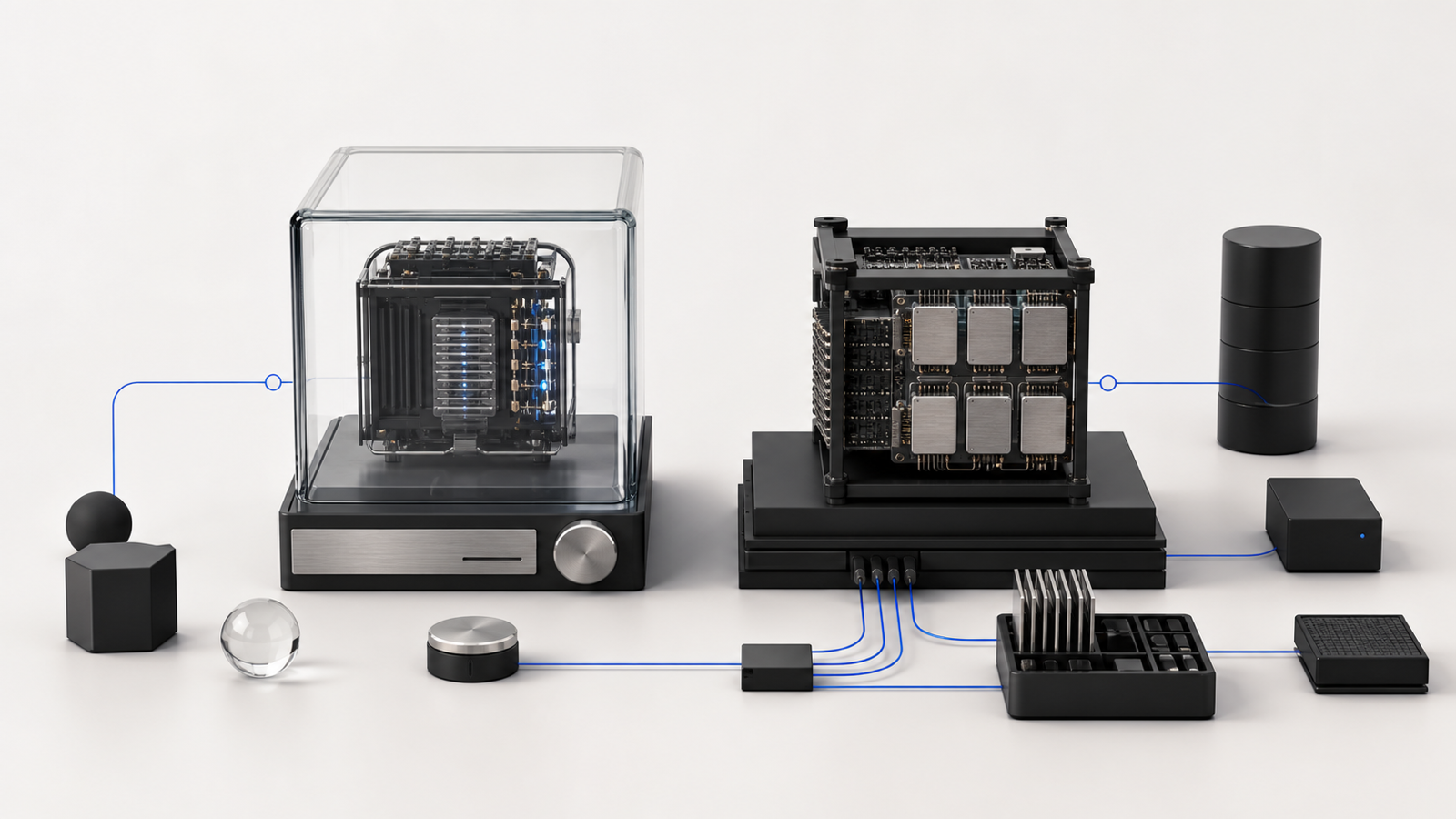
"Can we switch to the open-source model because it is free and just as good?" sounds like a straightforward cost question. Neither assumption is reliably true. Untangling them matters because the open-weight versus closed-model choice affects control, privacy, capability, and the amount of technical work the business must own.
Here's the actual distinction. A closed model — Claude, GPT, Gemini, and similar — lives on someone else's servers. You send a request over the internet, their infrastructure runs it, and you get an answer back. You never touch the underlying model file, and you never could even if you wanted to; it's locked inside a company's data center. An open-weight model — Llama, Mistral, DeepSeek, Qwen are the names you'll hear most — is different in one specific way: the company that trained it publishes the actual weights, the enormous file of numbers that constitutes the trained model, and lets anyone download it. You can put that file on your own hardware, or rent hardware from a cloud provider, and run the model yourself, entirely outside that company's infrastructure.
That's it. That's the whole distinction. It sounds small, but it's the difference between renting an apartment and owning a building, and it matters a lot in practice. What it does not mean, despite the name "open source" getting thrown around loosely, is that the training data is public, that the training code is public, or that you could reproduce the model from scratch if you wanted to. In almost every case, the company still keeps the recipe — what data went in, how it was filtered, what the training process actually looked like — as a trade secret. Open-weight means "here's the finished cake, take it home." It does not mean "here's the recipe." Calling that "open source" the way we'd use the term for, say, an open-source database, is a bit of a stretch, and it's worth knowing that going in so you're not surprised later.
So why would a small business care about any of this? A few real reasons, and they're worth taking seriously rather than dismissing as engineer trivia. The biggest one is control over data. If you're running a model on your own servers, your customer data, your contracts, your internal documents never leave your building or your private cloud account — nothing gets sent to a third party's API at all. For a business in a regulated industry, or one handling data it's genuinely nervous about, that's not a nice-to-have, it's often the whole ballgame. A second reason is customization: you can take an open-weight model and further train it on your own material in a way that's much harder to do with a closed model behind an API. A third is insulation from a vendor's decisions — if a closed provider changes pricing, deprecates a model, or throttles access, you're at their mercy. Own the weights and nobody can take the model away from you or change the deal on you mid-stream.
Now the honest part, the part that gets glossed over in every excited LinkedIn post about "ditching the API and going open source to save money." Downloading a model file is free. Running it is not. These models need serious hardware — the kind of GPUs that cost real money to buy or rent, and the bigger, more capable open-weight models need a lot of them running continuously. Then you need someone who actually knows how to deploy the thing, keep it running reliably, patch it, monitor it, and troubleshoot it when it breaks at 11pm on a Friday, which it will. That's not a task you hand to whoever's good with Excel. That's a specialized skill, and it either means hiring for it, which is expensive, or contracting it out, which is also expensive, or you personally becoming reasonably fluent in infrastructure you didn't ask to learn.
The myth to discard is "open source means free." It does not, not for a business trying to run a model in production. The model weights may cost nothing. Everything around them — servers, electricity, redundancy, security hardening, and the people keeping the system alive — costs real money, often more per month than a small business would spend calling a closed API for the same workload. Fictional example: A company nearly commits to self-hosting because the model is free, without pricing the GPU bill or noticing that nobody on staff can maintain a production model server. The free part is the smallest part of the actual cost.
So when does open-weight make sense for a small, lean business without an engineering department? Less often than the hype suggests. It makes sense when you have a specific privacy requirement that a closed API cannot satisfy under any available contract — certain healthcare, legal, or financial situations land here. It can also make sense for a very high, steady volume of a narrow task, when owning compute becomes cheaper than renting it, or when deep fine-tuning on proprietary material is essential and an API will not allow it. Outside those cases, paying a closed provider by the token and letting it handle the infrastructure is often the more rational choice, not a compromise.
There's also a middle path worth knowing about, because it's the one most small businesses that do want open-weight benefits actually land on: hosted providers who run the open-weight models on their own infrastructure and offer them to you as an API, same as a closed model, just with an open-weight model underneath. You get some of the benefits — often better pricing, sometimes better data terms, no vendor lock to a single model family — without taking on the server-management burden yourself. It's a reasonable compromise, and it's usually a more realistic starting point than buying GPUs.
The bigger lesson here isn't really about which acronym to prefer. It's that "open" in AI is a spectrum, not a light switch, and every point on that spectrum comes with a real bill attached somewhere — in dollars, in engineering hours, or in both. Anyone selling you a version of this where you get total control and it's also free is selling you something that doesn't exist. Figure out what you're actually protecting or optimizing for first — data privacy, cost at scale, customization, independence from a vendor — and then work backward to whether open-weight earns its keep for your specific situation, because for most small businesses, in most cases, it doesn't, and that's fine.
013 Labs publishes the practical version of these decisions because "open-source AI" is often sold by emphasizing the free model and minimizing the engineering around it. The boring, accurate version is more useful.