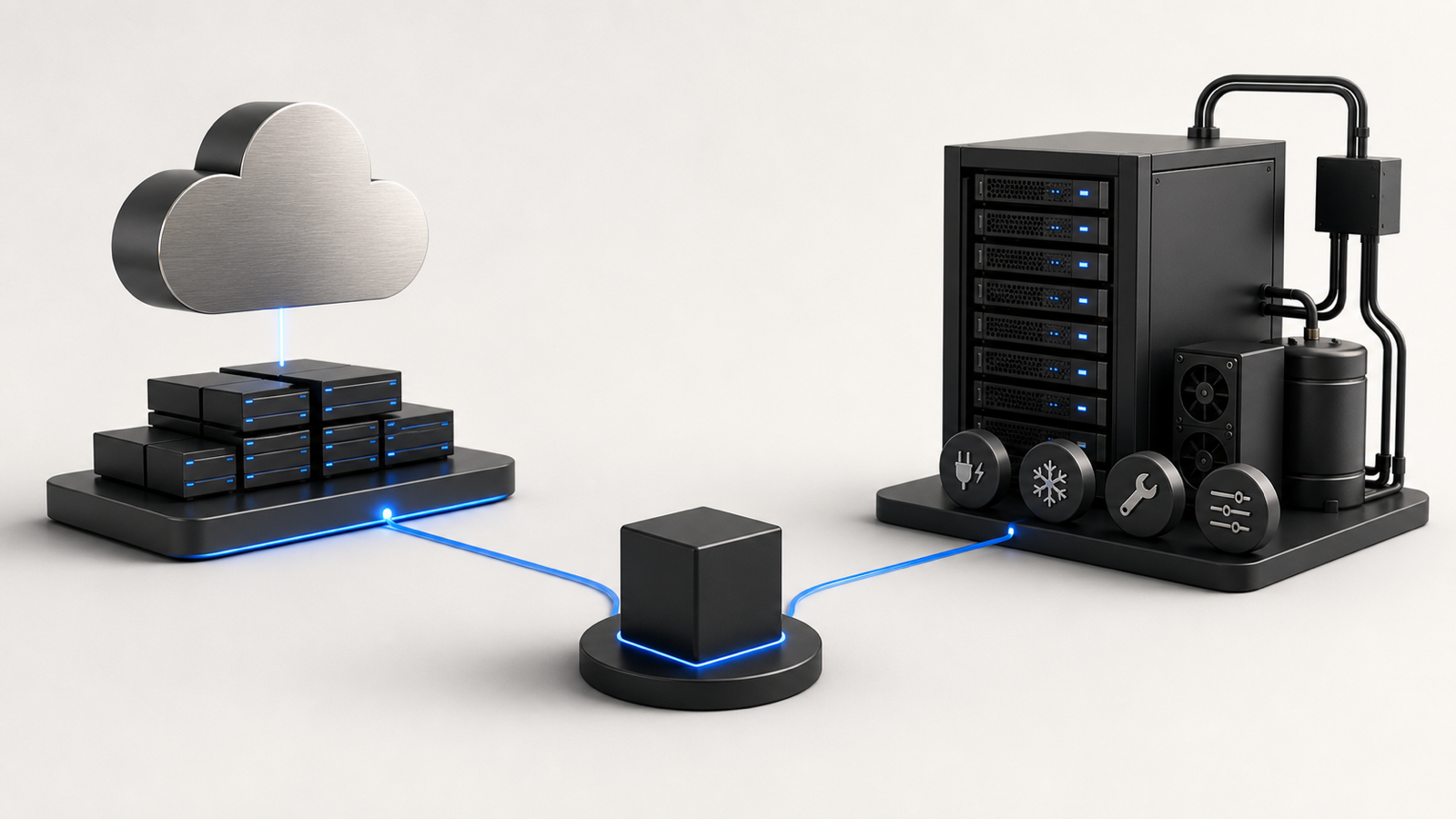
Should a business "run its own AI" instead of paying for ChatGPT, Claude, or API usage every month? Downloading an open-weight model and running it on owned hardware can sound like the grown-up choice — less dependence on another company, more control, and perhaps lower long-term cost. The honest answer takes longer than "yes" or "no," because the meter does not disappear; the costs and responsibilities simply change. Here is what actually changes when you run a model yourself instead of calling one over the internet.
When you use a cloud AI service — Claude, ChatGPT, or any of the other hosted options — you are renting access to a model that somebody else built, trained, is running on hardware they own, and is patching, scaling, and securing around the clock without you thinking about any of it. You send a request, you get an answer, you get billed for what you used. The provider handles the parts that would otherwise eat your week: making sure the servers don't fall over during a traffic spike, keeping the software current, applying security fixes, and swapping in a better model version when one becomes available. You never see any of that work. That invisibility is the entire value proposition.
Self-hosting means you take on all of that invisible work yourself. Concretely, it means downloading an open-weight model — there are several capable ones available now — and running it on hardware that can actually hold it in memory and process requests fast enough to be useful. For serving a real business workload, not just experimenting on your own laptop, that hardware means server-grade GPUs built for sustained, concurrent load, not the card in a gaming PC. Depending on the size of model you want, you're looking at anywhere from a single high-end card to a rack of them, costing anywhere from a few thousand to well over a hundred thousand dollars, plus the server chassis, networking, and power and cooling to keep it all running without melting down.
And buying the hardware is the easy part. Someone has to set up the inference software, configure it correctly, monitor it for crashes and slowdowns, apply security patches to the operating system and the serving stack, and troubleshoot it at two in the morning when it stops responding. This is not a job you hand to "the IT person" who manages your printers and your Wi-Fi. It requires someone who understands how these models are served, how to size hardware for expected load, how to quantize or optimize a model so it fits your GPU budget, and how to keep the whole stack secure. That person either already exists on your team, in which case you're paying their salary regardless of whether the server is idle, or you have to hire or contract them, which is its own ongoing cost separate from the hardware.
Then there's the treadmill nobody mentions when they talk about self-hosting: model quality moves fast. The open-weight model you carefully deployed and tuned six months ago is very likely behind what's available today, both from other open models and from whatever the cloud providers have shipped since. Cloud services fold those improvements in for you automatically, often without you noticing a jump happened. Self-hosting means you own the decision of when to re-evaluate, re-test, and redeploy a newer model, which is real work every single time, not a background update that happens while you sleep.
So where's the upside? The honest case for self-hosting is data control. If you run the model on hardware you own, in a facility you control, your data never leaves your walls to be processed by a third party, even briefly. For some businesses that matters enormously — not as a vague preference, but because of a contract, a regulator, or a client who requires it in writing. It's worth knowing, though, that this argument has gotten weaker over the past couple of years, because major cloud AI providers now offer enterprise agreements with options like zero data retention, no training on your inputs, and audited security certifications that satisfy a lot of the same requirements people used to think only self-hosting could solve. So before treating privacy as the trump card, it's worth checking whether a properly configured enterprise agreement with a cloud provider already gets you there.
For the vast majority of small and mid-size businesses, self-hosting is a distraction dressed up as a strategic decision. The math rarely works: you're trading a predictable, scaling-with-usage cloud bill for a large upfront hardware purchase, an ongoing specialized-labor cost, and a maintenance burden that has nothing to do with the actual thing your business sells. It is easy to get excited about "owning your AI infrastructure" and then spend months of a scarce technical hire's time keeping a server running instead of improving the product or serving customers. That opportunity cost does not show up on the hardware invoice, but it is often the biggest number in the equation.
There are real situations where self-hosting is the right call, though, and it's worth being specific about them rather than pretending they don't exist. If you're in a regulated industry — certain healthcare, defense, or legal contexts — where a contract or regulation genuinely requires that data never transit outside your infrastructure, self-hosting may not be optional. If you're operating somewhere genuinely offline or air-gapped, like a manufacturing floor with no reliable connectivity, a local model is the only model that works at all. And if you have a narrow, high-volume, repetitive task — not general-purpose chat, but one specific job done millions of times a month — the unit economics can flip, and a smaller model fine-tuned for exactly that task, run on hardware you own, can end up cheaper than paying per-call at that scale.
If none of those describe your situation, the practical advice is simple: don't self-host because it feels more serious or technical, self-host only when you've hit a wall with cloud APIs that's clearly about a hard data-control requirement or a cost curve that genuinely inverts at your volume. Start with the cloud option, get real usage data, and let an actual constraint — not a hunch — be what pushes you toward running your own hardware.
I write about this kind of thing at 013labs.com, where I try to cut through the parts of AI advice that sound impressive but don't hold up once you actually price out what they require.