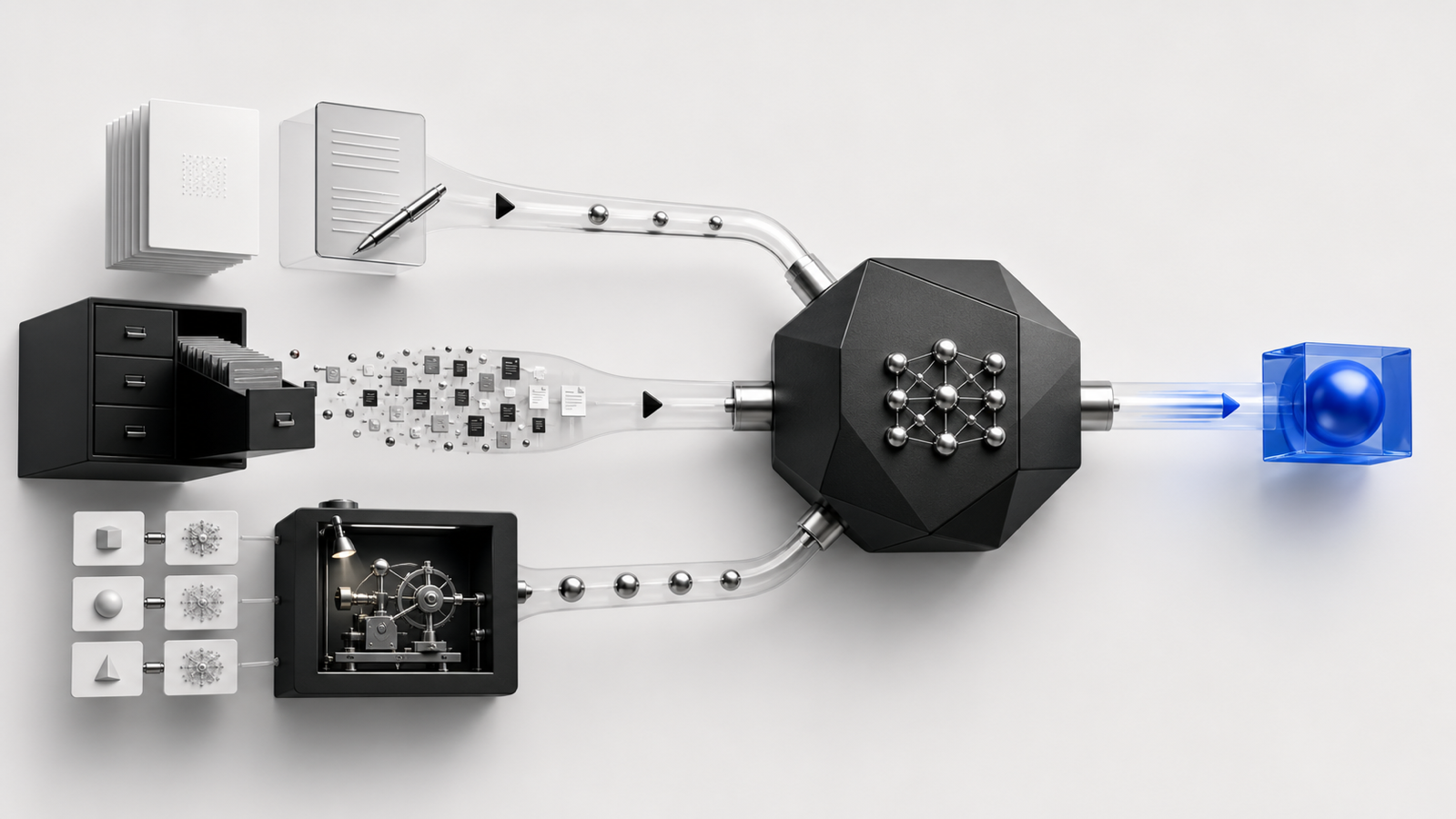
"Can we just fine-tune the AI on our own data so it really knows us?" is a natural question. Fine-tuning can sound like the advanced move, the thing serious companies do, while anything short of it feels temporary. But there are three real ways to get a model to work with your business's specific information and voice, and fine-tuning is the one most businesses will almost never need. The other two — prompting with context and RAG — cover the overwhelming majority of what small and mid-size businesses actually want. Here is an honest comparison of what each option costs in time, money, and maintenance, because the wrong choice can waste both budget and months.
The simplest approach, and the one most people underestimate, is prompting with context. This means telling the model what it needs to know inside the conversation itself — your pricing sheet, return policy, a few example emails in your voice, or a short product catalog. No training, no infrastructure, no data pipeline. You write it once, put it in a system prompt or project instructions, and the model uses it for that conversation. For a huge share of small-business uses — a customer service assistant, a first-draft email writer, or a tool that explains services in your tone — this is not a stepping stone to the real solution. It is the real solution. Weeks of worrying about the "proper" AI architecture can sometimes be replaced by three clear paragraphs of context.
The limit of prompting is simply size and freshness. Every model has a maximum amount of text it can hold in a single conversation, and even within that limit, models tend to get less reliable the more you cram in — a hundred pages of policy documents shoved into one prompt tends to produce answers that miss things buried in the middle, a known weak spot for long-context recall. And a prompt is static. If your inventory changes daily or your knowledge base has hundreds of documents, you don't want to re-paste all of it into every conversation. That's the specific gap RAG is built to close, and I've written about how RAG works in detail elsewhere on the site, so I won't re-cover that ground here. The short version for this comparison: RAG lets the model search across a much larger set of your documents and pull in only the relevant pieces for a given question, on the fly, so you're not limited to what fits in one prompt and you're not stuck re-writing context every time something changes.
Fine-tuning is a genuinely different thing, not a bigger version of the other two. Instead of giving the model information at the moment you ask it a question, you retrain the model itself — feeding it hundreds or thousands of examples of the input and output you want, so the model's internal behavior shifts to match that pattern by default. Done well, it can bake in a very specific voice, a very specific output format, or a very specific way of handling a narrow task, without you having to explain it every single time. Done poorly, or done for the wrong reason, it's an expensive way to get roughly the same result you'd have gotten from a good prompt, except now it's harder to change.
Here's the part that doesn't get said enough: fine-tuning requires a real dataset. Not five examples — a meaningful volume of clean, consistent, representative examples of exactly the behavior you want, usually built by someone who understands both the business and the mechanics of preparing training data. It requires compute cost to actually run the training. It requires evaluation, because a fine-tuned model can quietly get worse at things you didn't train it on while getting better at the thing you did. And it requires you to redo a chunk of that work every time your business changes in a meaningful way — new pricing, new product line, new tone from a rebrand. None of that is disqualifying for the right situation. But it's a genuinely different cost profile than pasting an updated document into a prompt, and a lot of business owners don't find that out until they're partway into a fine-tuning project that a good system prompt would have solved in an afternoon.
Fictional example: A specialty retailer wants product descriptions in the founder's particular voice: a little dry, a little self-deprecating, and allergic to marketing-speak. Fine-tuning feels like the serious, permanent solution to "make it sound like us." But ten example descriptions in the prompt and a clear written style guide can solve the same tone problem in an afternoon instead of weeks. When the retailer wants a looser tone for a holiday campaign, it edits a paragraph instead of retraining a model.
That's not to say fine-tuning never earns its keep. It tends to make sense when you have a narrow, high-volume, repetitive task where consistency matters more than flexibility — classifying thousands of incoming support tickets into fixed categories, generating output in a rigid structured format at a scale where even small prompt-following slips become expensive, or a task specific enough that no amount of in-context explanation gets the model to reliably do the odd, specific thing you need. It also tends to make more sense once you're operating at a volume where the per-conversation cost of a long context prompt or a RAG lookup actually adds up to real money, which is a different problem than most small businesses have. If you're sending a handful to a few hundred requests a day, that math almost never favors fine-tuning.
The other honest point is that these approaches aren't in competition with each other so much as they're a ladder, and most businesses don't need to climb very far up it. Start with prompting and context — it's fast, cheap, and reversible, and you'll learn a lot about what the model actually needs to know by watching where it gets things wrong. When your information outgrows a single prompt or changes too often to keep re-pasting, add RAG so the model can pull from a live, larger set of documents. Fine-tuning sits above both of those, and for a small or mid-size business, you'll usually find that the first two solve the actual problem before you ever need to reach for it. I say this as someone who could bill you for a fine-tuning project — I'd rather tell you honestly that you probably don't need one.
The blunt recommendation is to assume you don't need fine-tuning until you have genuinely outgrown prompting and RAG; most businesses will never outgrow them. Fine-tuning is a specialist tool for a narrow set of high-volume, highly specific problems, not a badge of AI sophistication. Chasing it early is a common way to burn budget and months on a solution to a problem the business did not actually have.
I write about this kind of thing regularly at 013labs.com, if you want more of it.